


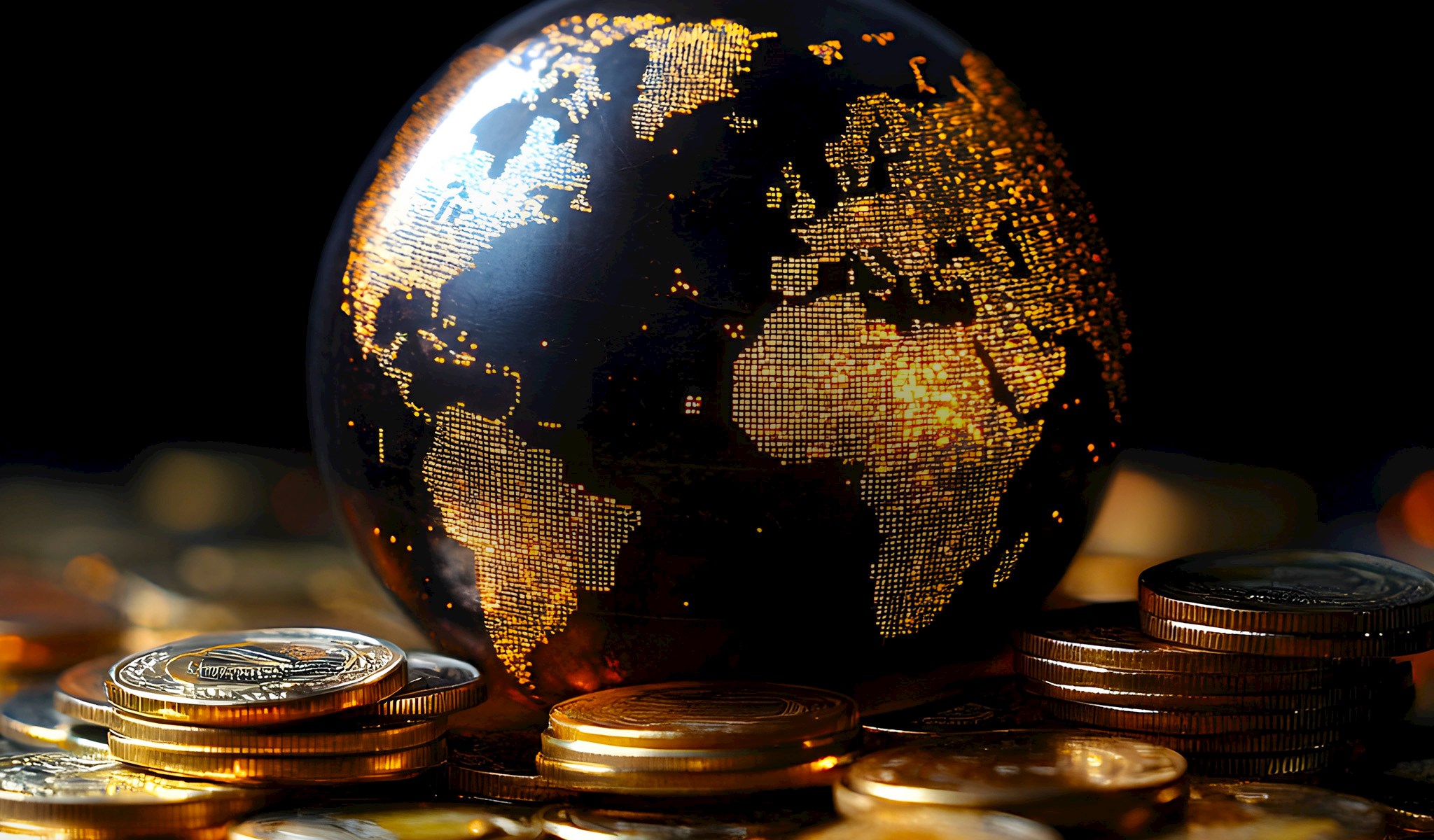
Macro strategist Luke Gromen, Founder and President of Forest for the Trees, joins William Blair's Jed Dorsheimer to explore the intricate relationship between gold, energy, and the evolving global monetary order. The conversation unpacks the historical shifts from Bretton Woods to the petrodollar, the rise of China, and why energy remains the foundation for economic resilience and future prosperity.
Subscribe here: Spotify | Apple Podcasts | Amazon Audible
Podcast Transcript
00:06 Jed Dorsheimer
All right. Welcome. My name is Jed Dorsheimer and I am your host at the Plugged In Podcast. Brought to you by William Blair. Today we are recording on December 17th, 2025. Christmas edition, I guess. And, maybe it will be a little gold for Christmas. So, my guest, Luke Gromen, is somebody that, I actually subscribe to his, macroeconomic, full report.
He is a strategist and founder of Forest for the Trees. That's his report. And, it's a research firm that focused on global monetary systems, geopolitics role a commodities and most importantly, someone that looks at energy as, a, the basis by which, economic systems are built off of. Or maybe I'm inferring too much, Luke Gromen, but I, I that's my read and you have, you probably best known for the work that you've done around, us dollar dynamic sovereign debt and gold.
And, you just put out an excellent piece last night, one that I've read three times. So I think I'm good to kind of, go through that with you, but, really gets into your thesis on gold, and I, I point out that you're probably the most bullish that I've, seen in terms of, what that means and most importantly, in this report, maybe as a starting point, you walk people through this longer time frame and then think, I'd love to start there, because he's you and I were just speaking before we hit the record.
I think one of the main problems today is our aperture for most is very narrow. And so if I kind of take my career that spanned, did three decades, which is long, I guess in, in Wall Street terms, like dog years. But, if we if we look at that, there's a couple Six Sigma events, but it's largely been in, a, guardrails on sort of a largely monetary driven, Fed sort of God type of what that says is going to determine.
And there's some, polls that if you open the aperture, even wider, going back to the Great Depression and sort of look at the post-World War Two order, if those tectonic plates are changing, then it really has profound implications for everything downstream. And you do a really good job in this report, and maybe you start walking us through sort of, a little history lesson on kind of 1971 to 1970 through and what happened with, sort of this move off of the Bretton Woods, to a Fiat and the implications for both gold and, and oil.
02:57 Luke Gromen
Sure. No. Thank you for that introduction, Jed. Yeah. The report we've highlight or that we wrote was looking at the history. So if we go back to the end of World War II, two, the allies all get together at Bretton Woods and they decide on a new monetary system. And there were two proposals, right. When you talk about widening that aperture, there were two proposals.
There was the, the non-American proposal, actually laid out by Keynes, which was let's move to a “Bancor,” what do you call a “Bancor,” neutral reserve asset in which to settle trade imbalances that occur naturally just by virtue of natural endowment of countries productivity levels, etc., that vary country to country. And he encouraged tying that to some sort of commodities.
The other proposal was the U.S. proposal. I think it was Harry Dexter White. And the American proposal was we're going to peg the dollar to gold at $35 an ounce, and every other currency will be tied to the dollar and managed and practically speaking, the Americans and all the men, all the factories, all the weapons, all the gold.
And so, as the old saying goes, he who has the gold makes the rules. So, we went with the American system. And what we highlight in this report is when you look at, you know, the title of the report yesterday was why we think the gold oil ratio is likely to continue rising secularly, and so the there's a lot of people talking about the gold oil ratio, today its about 76 barrels per ounce of gold.
It's up from six barrels per ounce of gold in 2008. A lot of people saying that's going to mean revert. We think there is very little chance it's going to mean revert. And so, we start by looking 1946 to 1971. We can see the gold oil ratio, very steady, remarkably steady. And I think for most of that time, if I'm recalling correctly, I think the price of oil was fixed, and the price of gold was fixed to the dollar, which I mean, for literally a good chunk of that time, it’s just a straight line.
1971 that all changes when the U.S. goes off the gold standard or closes the gold window under Nixon. Everyone knows that date. What we highlight in this report is a history, or a version of those events, that not a lot of people know. We cite a book written by William Engdahl called Century of War.
And then we also cite an interview with Saudi Foreign Minister, former Saudi Oil Energy Minister, excuse me, Sheikh Yamani, from an interview he gave with the UK Guardian in 2001. Both of those sources say that Kissinger, specifically, and the Americans, more broadly, along with the Brits dictated to the world in 1973, at a Bilderberg meeting in Sweden, that the price of oil was going to be raised 400% soon, as a way of increasing demand for dollars globally, since oil was priced by convention, then in dollars, and also increasing petrodollar flows, as what Kissinger called them back into our markets.
Basically, the goal here was twofold. It was to diversify Western energy supplies from a geo strategic perspective, given the price of oil as it stood in middle of 1973. You could see clear to where the Middle East was going to supply most of the world's oil. And that was a strategic risk for the Americans.
And the Americans and the Brits knew that at a higher price of oil, UK North Sea would come online. Alaska, Prudhoe Bay would come online, and that there was probably some oil at deepwater Gulf of Mexico that would be made economic if the price of oil rose enough. That was the that was the first reason they did it.
But then the second reason is, it created a support for the dollar. You had to have oil. And if it's only priced in dollars, then you have to have dollars. And they understood this. And these sources show that they understand this. That's the first part of the story. The next part of the story, then, is you have to manage and discredit gold, because, ultimately, if you look at a situation where the price of oil, the amount of oil being used is rising, the price of oil is rising, that's going to be a lot of oil surpluses.
And, historically, oil loves gold. We didn't get into this in this particular report, but we've written about it in the past. I believe it is in The Prize. The book, The Prize, about the development of the industry. But the original deal the Americans had with the Saudis was oil for gold.
And we basically cleaned out the world of gold bullion, shipping it to the Saudis for oil. And so, if the price of oil was going to rise 400%, then, what that would risk driving is the price of gold would rise more as an oil market that has consistently been 10 to 20 times the size of gold in terms of annual physical production terms, would bid up gold, and the gold oil ratio would rise meaningfully.
And so the gold price had to be managed. How was this done? Again, we cite multiple historical sources going back from WikiLeaks, noting a 1974 U.S. embassy cable from London saying that the creation of gold futures, very large in size relative to the underlying gold market, would create gold market volatility and dissuade Americans from buying physical gold.
We can go back to Sir Eddie George, the governor of the Bank of England, in 1999, saying that the Americans and the Bank of England had the Fed and the BOE had had capped gold prices in late ‘99. We can go to Peter Hambro, a 40-year veteran of the gold bullion markets, saying that that the BIS and others had been managing gold prices all along, all via the creation of credit gold, paper gold.
It worked. You can look at this on a price chart, and you can see from 1973, ‘74 when oil goes up 400%, up until about 2008, the gold oil ratio remains, again, remarkably steady, despite a lot more oil dollars relative the amount of gold market cap, if you will, being created. How is it done? They created a lot of paper gold.
Why was it done? Because now, by dissuading flows into gold, that money flowed into the treasury market, instead. Treasuries, as a share of global FX reserve assets, went, in 1973, ‘74, I want to say was 10%, if that. It peaked at 90% of global FX reserves assets in 2008, which meant the Americans could run deficits without tiers.
And, in contrast, the gold share of FX reserves, which in ‘74 was 90%, fell to 10% by 2008. And this had a very clear set of outcomes, which is, Washington won, Wall Street won, because they were handling that debt, and the U.S industrial base and working in middle classes lost on a relative basis, as we had to offshore to create the deficits under this arrangement.
And so that brings us to where we are now, which is 2000,…let me back up. This system worked for 30 years. It started to break down in ‘03 for a couple of reasons. Number one, peak cheap oil. We were starting to see some of the world's super giant oil fields run into marginal production problems.
Matt Simmons famously wrote his book Twilight in the Desert in ’05. And so peak cheap oil is starting to put upward pressure on oil prices. And, then number two, China entered the world economy in a big way and started using a lot more oil. And so, what we show in this report is that from ‘73 to ‘03, we kept the gold oil ratio steady to keep gold from competing with treasuries.
And then we also saw the dollar was essentially kept, what we call, as good as gold for oil which is basically oil from ‘73 through ’03 traded between $15 a barrel and $25 a barrel most of that time. It was essentially an oil backed dollar. And when oil got the 25, 30 bucks, the Fed was tightening, and Saudi was growing production or raising production to keep oil in that range and vice versa. When oil got near the low end of the range, you would see the Fed cutting and you would see Saudi tightening production to try to keep oil prices up.
And all of that could work because we were the biggest economy in the world. The Fed was the center of things. And that worked for 30 years. And like I said, that relationship of keeping oil between 15 and $25 a barrel, keeping the dollar as good as gold for oil, broke down in ’03. Number one because of peak cheap oil.
And then number two, and this was really, I think, the straw that broke the camel's back, China entering into the world economy as peak cheap oil goes to $30, $35, $40 in the mid 2000s, $50. And the Fed starts tightening rates, and promptly breaks the subprime market. And so, in 2006, 2007, the Fed faces a choice. The oil market under the petrodollar currency deal of the prior 30 years is saying oil's a $55, $60.
It's supposed to be, the dollar's collapsing against oil. The Treasury market is collapsing against oil. The Fed should be raising rates to crush the economy, crush oil demand, and to defend the system. The problem is that the Fed hikes that they did, were now blowing up the banking system via subprime. So in 2007, the Fed faced a choice, keep hiking and blow up the banking system, or start cutting to save the banking system and lose the relationship with oil.
And of course, they cut rates. And we can see in ’07, ’08, oil goes from $70 to $150 in about nine months. And, paradoxically, accelerates exactly what the Fed was trying to avoid in terms of blowing up the banking system, subprime, etc.. And so between the ‘03 time frame, when we saw the fed cutting rates, ’01 to ’03, Fed cutting rates with oil prices getting up near the top end of the range, and then in the ‘07 timeframe where they could cut rates with oil way above the top end of the range.
This system of we're going to keep the dollar as good as gold for oil fell apart. The Americans had, by their actions, twice in six seven years shown we cannot and we will not keep the dollar as good as gold for oil anymore. And as a result, the world began shifting reserves back to gold. That started in ‘08.
That was the absolute low in the gold to oil ratio, at six barrels an ounce. That's when Russia started stockpiling gold again. And I think it's, I'll stop here after saying this last part, the gold oil ratio is essentially just a pressure gauge on the health of the U.S. dollar system and the petrodollar aspect of it specifically, which is to say a low gold to oil ratio means a relatively low gold price, relatively low competition for treasuries as global reserve asset, and a relatively high oil price, which means relatively healthy Petro flows and demand of petrol flows into dollar assets and also demand for dollars from the world to buy oil.
And conversely, a high gold to oil ratio means high gold prices, high competition for dollar assets and treasury markets, specifically, and a relatively low oil price, which means relatively low petrol flows, relatively low dollar demand for oil.
And so, de facto, a rise that we've seen since 2008 of the gold to oil ratio going from six barrels an ounce to 76 barrels an ounce, is a massive, massive weakening in the global dollar system. And a shift toward shift towards multi polarity, is what it's a symptom of. And that brings us to today. So, kind of a long-winded background to summarize the report.
I skipped around a bit. I apologize. But, that, I think, lays out kind of what we were talking about in this pretty completely.
16:09 Jed Dorsheimer
Yeah, a lot there to digest. But, one point I want to make that's, I think somewhat ironic is, I would arguably argue strongly that World War II was largely determined, in terms of the outcome, by energy, a combination of oil versus, Germany that had abundant coal and then, of course, nuclear.
And, you know, one of the benefits of tethering to a commodity is you can't get too far over your skis, where in a fiat, you can get leverage upon leverage, which can be both a very much a positive, as we've seen and could potentially be a negative.
And, so, as you look at what you described in terms of going from gold to oil to perhaps gold again, or certainly a gold to oil ratio in terms of and the rise of China, which presented a great opportunity because as we offshored, and the one of the things that I've measured is the energy intensity per dollar of GDP, which, coincidentally peaked in the 1920s at about 17 megajoules per dollar and has come all the way down to about 3.873 megajoules per dollar. Which just means that, you're not doing steel production in Bethlehem, PA anymore. And that's being done offshore. Which, as long as you have a partner, and the rise of China's industrial prowess, they needed to buy our treasuries in order to return for trade.
And so, we had this pretty good relationship where the sovereign debt issue in the U.S wasn't as big of an issue because we had partners that wanted to buy, starting with Japan, then South Korea, or maybe it was Middle East, South Korea or Japan, South Korea, and then, China. But China's, I guess, decoupling, if you will.
And the fact that oil and natural gas is something that they don't have and have to import has led to this gold. So, I guess, question for you, do you see it as China that's driving gold up and not a U.S. type of issue, in terms of desire to drive gold prices up?
Or do you see that somewhat differently that, in order to deal with the debt issue, maybe Bessent wants gold prices to go up. And so, how do you think about that? And then afterwards, I want to kind of come back to energy because I think that's the intrinsic link in all of these.
19:00 Luke Gromen
Yeah. I think it's in the interest of the U.S. and China. I think they each have an interest. And I think you raise a great point about World War II, right? Exactly. We have the oil production. The Russians had the oil production. Germans were trying to do coal liquids. There's some historians that say Germany went after the caucuses exactly for that reason.
And that ill-fated, invasion of the USSR was because they needed the oil. And it was a Hail Mary on their part. Who knows? But we can see the echoes of how important energy is in global geostrategic competition. Even if we go back to the U.S. moves in the ‘70s, right when we go off gold and go to effectively oil.
I want to be clear. It was a really a genius strategic move by Kissinger in the very short run, because what it did is it took someone with energy and commodity superiority to us, the Soviets, and because, remember, American oil production had peaked in 1970, and changed the terms of competition. So now we could print dollars for what the Soviets had to do work to lift out of the ground. And basically the rest of the world helped finance, through the dollar system tied to oil, the breaking of the Soviet Union.
In a perfect world, what would have happened after the Berlin Wall came down and the Soviet Union broke up, is we would have had another monetary conference to say, okay, this oil dollar system worked for this period of time, and now we need a new system with a neutral reserve asset, because otherwise America is just going to hollow out its defense industrial base.
And that'll be good in the short run. But it will leave U.S. extremely weakened at some point down the road. That's what a wise policymaker would have said, but it would have taken several decades of foresight. And, I mean, you and I were younger men in that in that timeframe. You remember how triumphalist it was?
It was just like, hey, we won. It's the end of history, you know? It's all going to be sunshine and roses forevermore. And so, we started off showing our production base first to Mexico, then to China. And all of that worked for China, as long as the treasuries are going to buy them what they need, because China's strategic vulnerability is imports, its oil and other commodities, it's energy.
And so if the dollar starts collapsing against energy, if their FX reserves held in dollars start collapsing against energy, that is a strategic threat to them and they know it. And importantly, we know it. There's a great interview by Kyle Bass a few years back on CNBC where he flat out lays out in 2019, hey, here's how we crush the Chinese. The Chinese only have $3 trillion reserves. They import a lot of oil. The price of oil is going to go up. They're going to run out of reserves, and they're going to have a ‘97 Southeast Asia crisis. And on the math, Kyle's exactly right. And he knows it.
The Chinese have known it for years, that this is a risk. And so, the reason the Chinese have moved away, they've moved back toward gold, is it's not so much they hate America… It is literally a weak spot for them. It is a matter of a matter of utmost national security. Their economy will collapse if they don't get away from the dollar, if they don't gain the ability to print yuan for oil and other imports, which they have done, supported by the Russians, the Iranians, the Venezuelans, certain others at times.
But A. nobody trusts the yuan over the dollar, probably not even Putin. And B. the Chinese want to keep their capital account managed. They want to keep it mostly closed. And so, they don't want to run the system that we run. They don't want to offshore their industrial base create a bunch of renminbi debt, in order to get the ability to print renminbi for commodities.
What they have done, is they have set up their capital account to be open on a limited basis through gold. And the gold floats in renminbi and the gold floats in oil. And so, the gold to oil ratio rising is a symptom of this system gaining traction. People have been looking around waiting for the renminbi to collapse against the dollar.
They missed the show. The renminbi is absolutely collapsed against gold over the last five years. Collapsed. It's down over 70% against gold. Chinese people own a lot of gold, so they're not exactly unhappy. It's balanced that way.
This energy core that you highlight, I think is so super important in how it has affected the decisions, how we got here and to draw on your point about Bessent, you know, we've now reached the point where our debt has gotten so high that it's a fiscal problem. It's a matter of critical national security for our biggest trading partner, and where a quorum of the factory based backing our country is located.
In terms of China, China can't stockpile treasuries as their wealth reserve because our debt pile is so high that we literally need, it’s a mathematical guarantee. It's a certainty that we have to devalue our debt relative. You know, we have to have negative real rates. We have to have our debt below inflation just to keep it sustainable. Well, what we're saying is we need our treasuries to collapse against oil, against energy over time, just to not nominally default on you, China.
Well, for China, that's a lose- lose. Either you're going to default on me or you're going to erode away my wealth asset, and I'm not going be able to afford to import energy anymore. And then I'm going to have a Southeast Asia currency crisis in China, blah, blah, blah. What do I do if I'm China? I go to gold. I work with partners to sell me my commodities, my energy in yuan, on the margin, doesn't have to be a lot of it, just has to be on the margin.
And then I provide for net settlement in gold at, which they've done. They have offshore renminbi clearing banks in London, Switzerland, Dubai, Hong Kong, Singapore. You know, three of the four biggest gold markets in the world, along with their own Shanghai.
So, for the four biggest gold markets in the world and the hub for the refining of 95% of the world's gold in Switzerland. So, they've set the system up. It's working. It's why the gold to oil ratio is where it is. It's why I think it's going a lot higher. But it's really not about gold, or the dollar, or renminbi. It's about energy.
25:54 Jed Dorsheimer
Yeah. I mean it's interesting to me. So first off, one of the things I just want to highlight, that I don't think there's any emotions from a state perspective. It's just understanding how the interests are aligned, and that states will always operate in their own self-serving interest above all else. And so, it is we look at, the way that I look at data is just a future lean on energy.
And it depends on, because capital, energy doesn't come from capital. Capital comes from energy. It's a really, really important point in terms of the layering. And this is where neoclassical economics has gotten it so wrong. And what's ironic is if you go, actually, back to the classical economists, they actually understood this. It was a concerted move post-World War II that we shifted in this direction because, I think, it was freely available and, like water around a fish, it never thought about that.
And, however, as we start to look at the interests of China and the interests of the West, but I'll just use U.S. for this example. We'll limit it to the two superpowers right now. The U.S. has a vulnerability on the amount that we, if I look at a spectrum and I have on one end resilience and on the other end efficiency, we went very high on the efficiency coming down from 17 Megajoules to 3.8.
And China actually looks the exact opposite because they were the beneficiary of that offshoring, or Southeast Asia was, but really China in terms of. So, the energy intensity increased. So, if there's a decoupling though, this is where, if everybody wanted the same thing from a diplomatic perspective, there is a yin and yang, but it seems that we're not close to that in terms of at least the signals.
So, the U.S. ostensibly has to bring back energy in order to get to some level of resilience, to be self-sufficient if we're going to decouple, and this has military or defense implications and widespread in terms of what we actually make. And, I guess my question for you is, in a world where AI and information seems like it's the future commodity or currency, how do you think about China returning back to, so if you think about the arc of this, you go from gold to really oil, and then China is trying to go back to gold, and deal with their structural vulnerability, which is lack of gas, lack of oil. And then the U.S. is looking at bringing back energy. Do we go gold or do we look crypto?
How are you thinking about that shift, in terms of, what is the future commodity that backs currency?
29:27 Luke Gromen
The short answer is I don't know. I agree with the framing of that. I think that shale was, in part, a market driven response to, it was sort of the first down payment of this, right? American policymakers understood still that we're alive then from the ‘70s, the way you reduce dependency on the Middle East is you get oil prices up.
The shale was not something they figured out in 2001 or 2005. You know, they knew about the shale deposits back in the mid-‘80s, late ‘70s. It was all just a question of price initially. And then to really get the returns, some of the technology long, long lateral steerable depth technologies. But, it wasn't like they just discovered that, that they knew to that they got priced to a certain level, domestic production would pick up.
So, we did return some energy that way. I would amend or addend your point that we need to return energy to, we need to return midstream. We even if, you know, we hear once or twice a week, yay, we found this big lithium deposit or we're going to produce more rare earths here. Great. Where are you going to send it to refine it?
And they very rarely say that in the releases. And no one ever asks the question because no one wants to be the spoil smart at the at the party. Because the answer would be, we have to send it to China to get refined. And this to me is the fundamental issue of the next five to 10 to 15 years for investing.
And it faces the Defense Department, and it faces the Treasury Department, which is we need to bring back midstream because otherwise all we're doing is digging up our stuff, sending it to China.
But to bring back midstream, we've got to increase that energy intensity, which is a very, I would say it's a technical way of we need to inflate a ton. We need wages to go up. We need industrial production to go up. We need pollution to go up a ton. And let's just set aside the political difficulties of regulatory and environmental and what have you, and say we can resolve those quickly, which we probably can't.
The reality is, is the Treasury market as it sits today, if you came out and said we are going to bring back midstream for our entire defense industrial base, broadly speaking, and go from wherever 3.7 whatever megajoules per dollar to- no, don't even take it all the way back. Take it back there.
You are saying that inflation's going to ten. That's what the announcement says. And the markets won't figure it out right away, but they will pretty quickly. The problem is our debt levels are so high, by virtue of the remnants of the past now dying or dead system, the ten year Treasury yield can't afford five.
Everything starts to unwind globally at 5% yield on the ten year. We've seen this empirically, repeatedly. My point here is announcing the reshoring of the midstream, in just a quorum of it, would quickly crash the bond market and force the Fed into a choice of do you stand aside and let inflation really rip? Basically, buy the bond market into inflation that's on its way to 10%?
Or do you stand aside and wait for the banking system to start collapsing because yields are wherever they are. And that to me is the macro question of the next 5 to 10 years, if we make the assumption that we are going to move back towards resiliency in a way from efficiency, if we're going to bring back the midstream processing. And I think that the odds of us not doing that are de minimis, because we've seen it now moving in that direction for three straight administrations.
Trump started it. Biden continued it with a different, slightly different flavor. And now Trump has accelerated it meaningfully. And so, I don't know, I have high conviction that ultimately what this means is basically the Fed is going to have to buy a large share of the Treasury market.
The Fed is going to have to buy a large share of the bond market, the mortgage-backed market, etc. basically, in World War II type yield curve control. But in the meantime, we're going to see capital costs continue to rise. These stresses we're seeing in financial markets at the front end in recent months, these rising long end rates around the world.
The fact that oil has plunged and ten year Treasury yields, contrary to Bessent’s expectations have not. These are all symptoms of this fundamental question, which is and oh, by the way, the reason gold has completely separated from U.S real rates in addition to the sanctions on Russia, etc., have been higher rates or lower rates at this point, at these levels of debt, the GDP are good for gold because higher rates make the debt less sustainable and lower rates are inflationary. And so, gold doesn't care either way. It wins.
And, so, that is, to me, the big question. This is like the whole, this is like a huge deal. It's all-around energy and midstream of, if you want a divorce from China, you got to bring back the midstream.
And if you bring back the midstream, a processing of, kind of, everything, you've got to increase that energy intensity, and you've got to increase inflation. Barring, I think there's still a hope we can get some sort of fusion miracle. If we get some sort of fusion miracle, something like that, then you can do it in a way that you don't have to blow up the bond market, that the Fed doesn't have to buy it.
I'm not seeing anything yet that suggests that this is coming by next Christmas or two Christmases.
35:50 Jed Dorsheimer
You bring up a really good point. We put this white paper out called “Pain at the Plug,” and the fifth pillar, we lay out a five-point energy policy for the U.S. to get back to abundance. And the fifth one is moonshots. But, moonshots are only possible if you have the energy surplus to have a culture where you can take those risks.
So, if you go into a tightness, you actually can't. It stifles the innovation. And I think part of the reason the West in the U.S. in particular, has been leading from an innovation. I would go back for the same reason that World War II was decided, that we had the energy surplus that allowed for that petri dish of innovative culture to develop things.
And so, as the risk here, is that as you move to lower surplus from an energy perspective, like spending down a battery, you have knock on effects downstream of innovation, health care, arts, humanities, etc., that that will get tighter. And so, if I think of this venn diagram that we're, kind of, theoretically developing, the union on all of them is building out an energy base which, quite frankly, China is leading, by country mile, in terms of adding a coal fired plant every single week.
What's interesting is they’re air-cooled coal fired plants. You're paying a huge thermodynamic penalty or tax on that, which I think brings up a systemic water issue in China. And then two, they've got, I think, 26 nuclear plants underway. And so, I do think that there's time. But, the U.S. really if we get in the back and forth politically, like, I sort of think that this should be the most bipartisan issue that's on the table, and, kind of, getting back to firm baseload, which is just that we need industrial energy base, no matter how you look at like, this isn't an AI is a bubble or AI is not a bubble. It almost, from a defense posture, that building out the energy base should be priority number one for both Democrats and Republicans.
38:12 Luke Gromen
Well, you raise a great point about these things being downstream of that energy policy, that energy surplus, because it's another one of the unintended consequences and tragedies, really, missed opportunities, of not sitting down in ‘89 when the USSR collapses and setting up a new monetary conference to basically bring back a neutral reserve asset system that doesn't lead to the hollowing out and the and the massive financialization of the U.S. economy.
Because now the U.S. has a conundrum, which is, for 40 years, you've been sending your best and brightest into the financial markets, by and large. And I'm not denigrating any of our engineers. There are many bright, brilliant engineers. But, many people, I graduated from college in ‘97. I went to college in ‘93.
And it was an acute decision, I was told by one of my mentors, who was an engineer with British Petroleum and had been for years, and he said, listen, son, I got my degree in petroleum, nuclear engineering. He got a degree in nuclear engineering. He goes, if I was you, I would not go into engineering because all that’s going to happen is you're going to work a lot harder, and you're not going to enjoy college as much, and then you're going to go work for a few years as an engineer, and then the company is going to send you to business school, and you're going to get an MBA, and you're going to be in finance.
So, just go into finance. And I did, and he was 100% right. And millions, legion of millions of men and women America did the same thing. And so that's number one. You have to change that incentive, okay? The other problem, though, is since ‘95, we have tied the solvency of our government to those financial markets. So, in ‘95, there was legislation under Clinton where he was trying to actually reduce the wealth gap.
He was doing legislation, that cash comp over $1 million per year would no longer be deductible to the corporation. And then I guess they wrote in, at the last second, what have you that, stock-based comp would be exempted. And so, guess what happened? All of the executive comp shifted into stocks.
And from ‘95 on, the relationship between the equity markets and the federal government's marginal tax receipts basically moved to like 0.9 and a correlation with like a three month lag.
And, so, that leads to the fundamental conundrum, which is you need to de financialized the U.S. economy significantly in order to create the free market incentive for people to say, you get your brilliant people and go, I can work really hard and never go out and never make as much money as a guy who's in finance.
Or I can go into finance, create derivatives and what have you, make way more, work way less hard and what have you. And that that's, sort of, number one. But then number two, if you take down financial asset prices to incent this, to right size the finance, insurance, real estate side of your economy to create an energy surplus of people into these engineering these problems growing, building these problems, you immediately have a sovereign bond market crisis in America, because your tax receipts fall and you've your debt to GDP so high.
So basically, stocks go down 20%, which earlier in our careers was like oh this is a bad correction, but so what? You take stocks down 20% and leave them there for three months. Your receipts are going to be falling.
And with interest and entitlements where they are, you're literally going to be over 100% of receipts on interest and entitlements. If stocks fall 20% and stay there for three months, which means within three months, the American government is in print or default on entitlements on and its debt decision. So, to your point, not only are the Chinese running away with it on the energy side, but because we didn't make these decisions 40 years ago, 30 years ago, 20 years ago, we can't let the free market, we can't implement a free market decision of, well, let's do something that tanks markets, that redirects and diverts energy, human and energy capital into rebuilding the midstream.
The only way to do this is basically, print money, buy commodities, buy industrials, and let's see how long the bond market lets us get away with this until the Fed has to cap it. And I think that's basically where we are, when we see the Trump administration nationalizing antimony and nationalizing these critical minerals, when we see them incentivizing zinc investments in the billions of dollars in Tennessee, when we se. They're basically selling treasuries to buy commodities and trying to, kind of, do this and hoping the bond market won't know or won't notice too quickly.
But it's a very challenging thing because when you make the wrong decisions, financed by debt for long periods of time, sooner or later you're left with not just bad choices, galactically, terrible choices are the only things you have left. And that's, kind of, where we are, which is, inflate a whole bunch or collapse the whole system trying to bring back a midstream.
43:47 Jed Dorsheimer
Well, let me reframe a little bit for you and tell me what you think about this. So, we haven't had a rules-based order change in 80 years. So, let's go on the axiom that that is changing right now. And let's remove China from this equation for a second here.
But, assume China continues to try and promote the yuan and by doing so, is going to continue buying gold. So gold prices go up. Let's say gold doubles in price, hypothetically, it, kind of, gets into the ten to 11 thousand per ounce range in that scenario. That does give Secretary Bessent the opportunity to revalue U.S gold and deal with some of the debt, if not all of the debt issue.
But, it doesn't take away the need to. So again, if we look at the Venn diagram, the union and of all of it is you have to build out the energy systems, and, in doing so, also as you point out, build out midstream, so that you have some level of resilience. We calculate that that's, seven to nine megajoules per dollar is up from 3.8.
45:10 Jed Dorsheimer
So, basically a 250% increase. Now as you point out, correctly so, that would be hypothetically significantly inflationary, to the likes that we have not seen. And this is where I enter AI and data centers, where I wonder whether or not Sam Altman said the quiet part out loud in terms of getting the government to backstop.
So, where the financialization was too big to fail, does AI become the too big to fail and, therefore, the only effort to put a disinflationary hedge on the inflationary power build out? Pick that apart and tell me where I'm wrong in that analysis.
46:01 Luke Gromen
No, I think you're attacking exactly the right pivot points, right? Something we've been harping on for over a year is, the rules based global order is breaking down. It necessitates a restructuring of the U.S. economy. And with that a restructuring of the U.S. sovereign balance sheet.
And you have to start with the restructuring of the sovereign balance sheet, because anything else you do, the bond market is, we're so levered, it's going to shut down anything immediately. So, step one is restructuring the sovereign balance sheet. And you're exactly right. The financial accounting manual for Federal Reserve Banks, it's a publicly available document, section 2.10 provides for the Secretary Bessent to direct the Fed to revalue U.S. official gold from the $42 per ounce, where it still sits on the balance sheet today, up to the market price.
That, and any increase, would be directed into the Treasury General Account or TGA. That is, essentially, straight money printing based on the gold without any offsetting increase in debt.
Practically speaking, at 261million ounces, officially, every $4,000 per ounce and the price of gold is about $1 trillion into the TGA. And then you can get into, okay, total debts is $37, $38 trillion, but I think the size of the Treasury market is closer to $25 trillion. I think within that there's like $5 to $7 trillion.
That's kind of at the long end. To me, I would think you would want to anesthetize using a gold revaluation, most, if not all of the long end, because the short end, collateral needs in financial markets, stablecoins, blah, blah, blah, you can handle the short end.
48:02 Jed Dorsheimer
And when you're talking short and you're talking about, T-bill duration versus long end, in terms of the curve, and the exact thing that Secretary Bessent, I think, criticized Secretary Yellen in terms of being on the short. But it's structurally, that's challenged. So, it would give him the opportunity to then, adjust the curve. You know over that duration.
48:25 Luke Gromen
Yeah, he could, I mean, look at gold $20, 000 per ounce, if we were able to get market forces to do that. And I don't think it would be too hard. $20,000 per ounce, he directs and puts $5 trillion into the TGA. Free and clear. He can buy back the entire long end. That's step one.
Now, when we start to, step two, which is let's bring back the midstream more aggressively, let's build out, and inflation goes up a bunch. The bond market is going to sit there and snooze. It probably would require some sort of modest capital controls to any remaining debt holders. But if you've bought back the entire long end, you probably have to introduce some sort of like belly of the curve capital controls or something like that. Right? Like you own a three or five year? Congratulations. Those are now, turned over to maturity.
49:23 Jed Dorsheimer
The thing neither of us have talked about in this podcast so far, is what you would be doing, ostensibly, is building back the middle class, because, all of that midstream is going to require electricians, plumbers, workers that actually do things versus, pontificate on things. And so, you, kind of, get this, like I do. But you would end up having this, you restructure fundamentally the middle class to give you a stronger base, that then would give optionality on top of that.
49:56 Luke Gromen
That's exactly what it does, right? Just think about it. If getting rid of gold out of the system had a very clear set of winners and losers, the Treasury market won, Washington deficits, won, Washington power, relative and wealth won, Wall Street power and relative wealth won, and the U.S. industrial base and the middle and working class is lost.
If you go back to a neutral reserve system, or neutral asset system, which Bessent would be doing by doing this, essentially, the reverse would happen. I'm not saying it'd be bad for Wall Street. I'm just saying, as Bessent has said over and over and over, he said, it's not that Wall Street's going to lose. Its just its main streets turn, and you would see a lot more headlines like what we saw last week in the Wall Street Journal of contractors making $200, 000 a year in middle of nowhere Texas building data centers, except they would be building rail, and grid and building everything midstream again.
And that's exactly what it would do. It would be huge. It would be the biggest nominal GDP boom since the immediate aftermath of World War II. And it would be that globally, because the release valve would be the dollar. And, when gold goes up a ton in dollars, it's going to weaken the dollar a ton.
Well, think about where the world sits. The world, via the euro dollar market and elsewhere has $13, $15, $20 trillion in dollar denominated debt. It'd be like you and I taking out a mortgage in Mexican pesos, and then the peso collapses. And I'm not to say it's going to collapse or, well, it's like we owe of a mortgage in pesos and then the peso falls 40%.
Are we richer or are we poorer on a real basis? We're richer on a real basis. The world that is short dollars, via these dollar obligations, would be much wealthier on a real basis, and in a much better position to consume more of their own production, even as we try to produce more of our own consumption by bringing back the midstream.
And so, it remains poorly understood that, it's amazing to me how much all roads lead to gold. In other words, like it's on the books.
Gold is just a derivative of energy, right? Gold is simply stored energy. That's all it is, right? You know, so, you this system wouldn't be perfect, but it would much more closely aligned with your vision of, and my belief, your belief, of the base layers energy.
And so, we have separated the base layer from the paper, and it's just gone too far. And it's now hurting us. It's hurting China. It's hurting everybody. It's in everybody's interest to go back to something with a closer energy tie. Now, could that be Bitcoin here and gold there, to answer your question, sure. You know, bitcoin does have an energy tied to it via the proof of work etc..
That remains to be seen. I'm long term still very bullish on bitcoin. I think it could be used in that way, that then sets up a battle, really, between gold and bitcoin, which ultimately becomes a battle of who's more productive, right? The Chinese or the Americans? Well, given how productive the Chinese are culturally, energy, etc., that then becomes a currency issue, right?
Like, we can catch up with the productivity of the Chinese if we haircut the dollar enough against the yuan, which, then, it's just an FX rate issue at that point, if you want to try to stand up bitcoin against gold as a reserve asset.
53:48 Jed Dorsheimer
Yeah, I think what we just did is, kind of, the emergence of a new system is like an artist with a blank canvas. There's a lot of negativity that's spreading around like, oh, this is the doomsday. I actually look at it the exact opposite. Just, we have get back and get on the same page of what needs to be done.
But, if done correctly, there is a way through to adjust and deal where you can actually have a prosperous West, and you may even have a prosperous East, as well. What you probably won't have is if you don't have energy reserves and you're consuming more than what you have, that's probably structural loser in that situation.
But if I just pair it between East and West, it doesn't have to be a head on collision and conflict. You can actually develop a system that's quite prosperous. Could it go incredibly wrong? 100%, right. There's a lot of threading the needle that needs to occur, but I think it comes back to that re-anchoring on physical id the path, maybe that even more so than energy.
Although energy is the basis for physical. But in the heart of that, the union of the Venn diagram that I talk about, that is, all roads lead through, whether we're talking fiscal, monetary, trade, it all, kind of, goes through the same point.
55:33 Luke Gromen
You know, it's such a great point because I often get accused of being a doomer and it's actually the complete opposite of my message. I have three draft-aged sons. The alternative of this solution is they get drafted and go fight somewhere or get enlisted for that. That's the doomsday scenario.
Some, quarters are trying to pitch us, we need to go fight the Chinese somewhere. We need to go to war here, like, that's the doomsday scenario. The good scenario is change the monetary system. Take control of it away from the people that are electricity comes from a plug, and water comes from the faucet, and food comes from the grocery store, these policymakers and economists that have been running things into the ground for the last 50 years.
Tie it back to the real world of energy through gold, through Bitcoin, whatever, I don't care. But, that's the good outcome. And yes, because we've waited so long, and certain things are very extended, it’s not always going to be clean. There are needles to thread. It may not go well, but this is the good outcome and it's getting very late in the game, to where we simply won't have a choice.
We will wake up one day and the Chinese will say, we've had it. You've pushed us too far. The next shipment of iPhones we only want paid for in yuan or in gold, like you guys did to the Brits in 1940 when the Brits were on the downswing.
And I'm not saying we're necessarily on the downswing, but I can see the downswing from here. If we don't get back to a system that doesn't mandate us going into a downswing, which is what this present debt dollar system has been doing.
So, absolutely, It could lead to the biggest global economic boom. It's just a reversal. You know, it requires some humility from the people that have been enriched by the incumbent system. They have to be willing to let go of some relative wealth and power, and let the bottom that has lost a lot of relative wealth and power get back up off the mat.
And in the long run, it would be very good for them. That would be very good for those people. In the medium term, it'd be very good for those people. I'm hopeful we can get there. Part of why I do what I do and harp on this so much is because to me, it's so important.
And because I know what the alternative is. The alternative is my boys get drafted and go somewhere to fight, like the boys of 1939 did. And that's where this is heading. And so, I think it's really important to get this right, knowing that you've got ties in policy circles.
58:27 Jed Dorsheimer
I don't think you can have two nuclear superpowers in conflict. I think the stakes are too great. And we've kind of seen, even touching on that with respect to Ukraine. And so, I think this option, option B, is much more palatable. And, my messages, I've always found that if you help people make money along the way, they're more incented, they deeply believe, because it's worked.
And the benefit here is by looking at things through this lens, you're looking in the mirror and seeing reality versus fantasy. And there's very practical steps. We need to build firm base load fast. We need to shore up the supply chains. We need to change the economic incentives, versus the more we incentivize things that we know won't work or have low value, we should just call it a tax, which is what it is. Instead, we call it a subsidy, so, moving away from that.
And all of that's going to open up the opportunity for the moonshots that you talk about in term, whether it's fusion, or whether it's thorium-based fission, whatever it may be, it opens up our optionality. And I think that's a very exciting, hopefully it comes across, but I think there's a lot of opportunity here.
And I love your enthusiasm around gold, too, and how you're seeing these connections. It actually was reading your work that actually turned me on, because I never fully grasped the concept of what was actually happening. Now, I feel like I have a firm understanding of that. So, thank you.
1:01:00 Luke Gromen
You're welcome. Yeah. I mean, for me, what the Chinese are doing with gold is not about gold, it's all about energy. It's all about energy. And that, I think, is super important because, understandably, in some cases the gold bug community, there's a lot of skepticism around parts of it in policy circles.
And certainly, given sort of the economic dogma of the last 40 or 50 years, but if you just if you just look at gold as a store of energy, that's it. That's all it is. Gold is just a 0% yielding bond of infinite duration and infinite face value.
And tied to energy, that's all you're doing. You're just swapping out, a treasury bond that is infinite supply, a finite face value, finite duration, and increasingly disconnected from energy. You're swapping out one reserve asset for the other, to the benefit of everybody in the world.
1:01:29 Jed Dorsheimer
Well, if you're right, Luke, maybe you and I will finance some excavators and join Parker Schnabel up in the Yukon and get on the show gold rush to start mining some of this. $20,000 an ounce is a long move from where it is today.
Well, listen, thank you for coming on. You know, happy holidays and just let the audience know where they can find your work on Forest for the Trees.
1:02:05 Luke Gromen
Absolutely. Thank you. Yeah. https://fftt-treerings.com for more information about our institutional and mass market products. And they can find me on X @LukeGromen. I have a fairly active feed. And thank you very much for having me on. Merry Christmas and happy New Year to you, as well. And I hope you enjoy the time with your family.