


Another spring of uncertainty is necessitating creativity in global deal making. But expectations remain for strong growth in secondaries, especially as the market applies lessons learned from 2025.
For secondaries, 2026 began with great optimism—a hallmark of the sector in recent years—as insiders surveyed by William Blair projected $250 billion inactivity by year-end (see chart). But macro disruptions emerged early in the year, similar to the situation surrounding U.S. tariff announcements in spring 2025.
Despite the latest uncertainty, trillions of dollars of unrealized value across private funds have continued to support growth in secondaries—and while disruptions related to the conflict in Iran and AI are making their way through the market, they appear temporary in the face of a longer-term, structural need for liquidity. Investors, so far, have mostly shrugged off Iran-related turmoil. But AI has been more complicated, remaining a topic of conversation, with some software-exposed transactions disrupted for the time being.
Global Secondary Market Volume (in Billions)
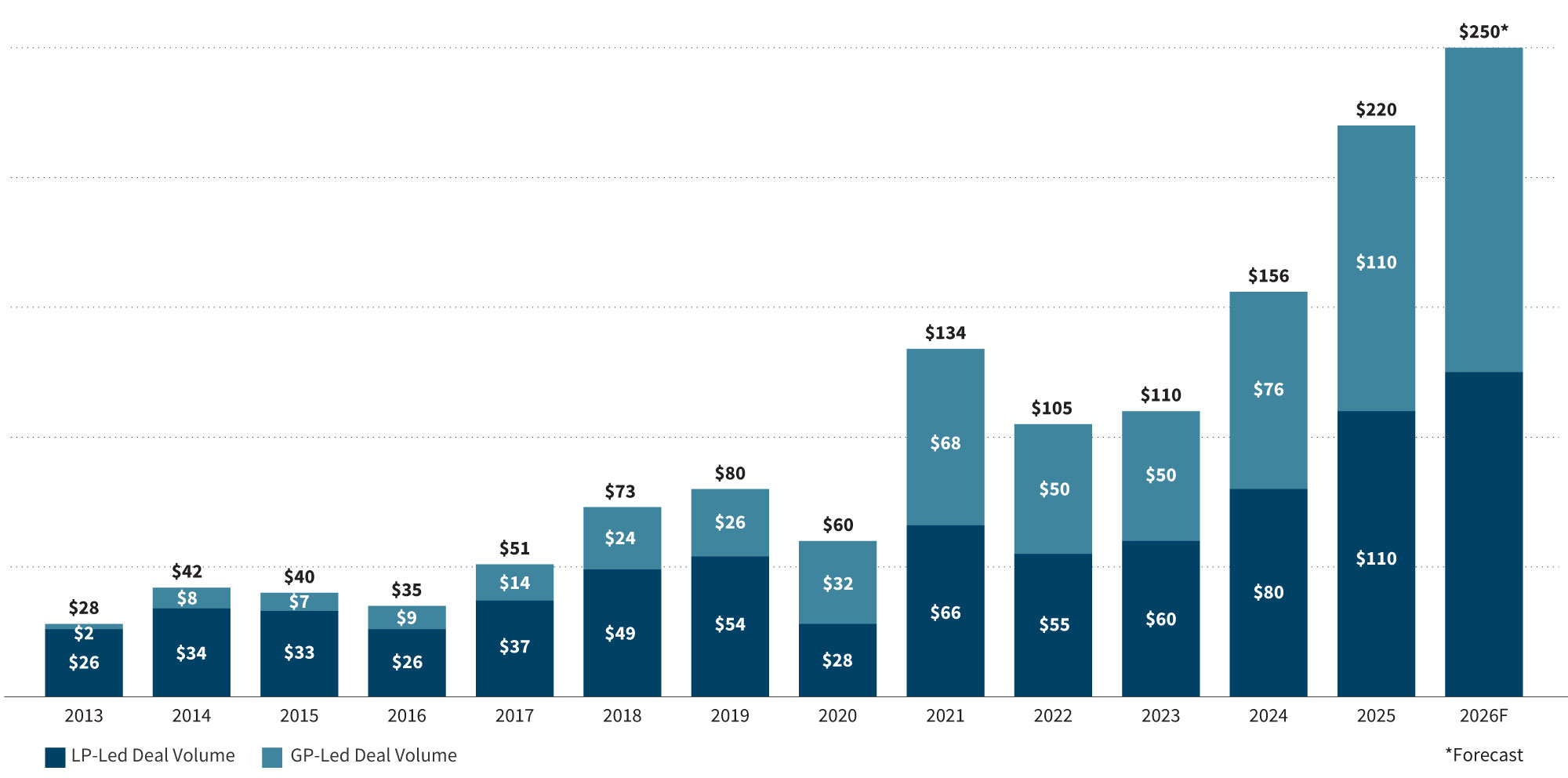
Still, one may look at 2025 for an example of how the secondary market can play the role of a stabilizing force amid the ups and downs of the IPO and M&A markets—and indeed market participants expect much of the same from the secondary market in 2026. The following report examines the LP- and GP-led markets thus far in 2026 and discusses what could lie ahead for secondaries in the coming months.
How Have LP-Leds Dealt With 2026’s Macro Turbulence?
Last year, LP-led deal activity stalled after the Trump administration’s April 2025 tariff announcements—only to surge shortly thereafter. The result was a glut of attractive deal flow that surpassed the market’s capacity in midsummer before evening out in the fall. The booming market led to sellers verging on what we would describe as opportunistic.
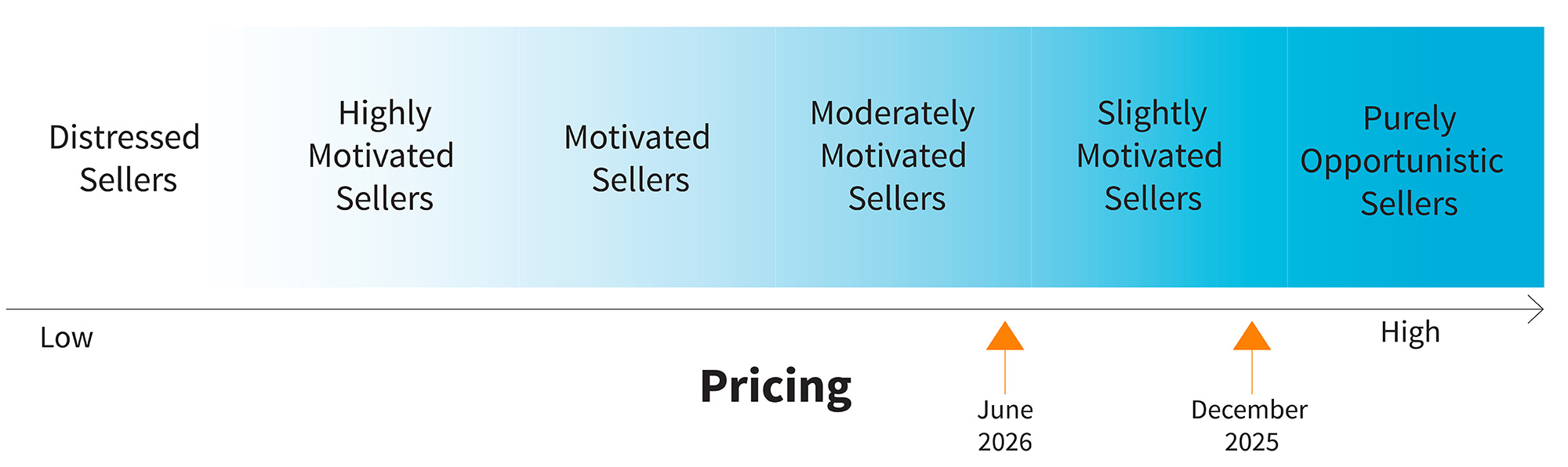
In the end, 2025 smashed records for LP-led activity, and the hope is that investors will look back and be less fazed by the potential for macro disruption this year. But, at the moment, sellers on the LP-led side would be best described as moderately motivated, compared with slightly motivated and verging on opportunistic in December (see chart) as buyers wait to see how valuation change is reflected in first-quarter marks for tech assets amid AI-related uncertainty.
Activity is expected to stabilize sooner than last year, with marks poised to improve and slower distributions expected to drive scaled sellers to market. Further, a possible run on’40 Act redemptions could prompt the sale of assets, supporting a full cycle of the secular “democratization of alternatives.”
Consolidation of secondary platforms has also been a theme in 2026, with insiders expecting the trend to continue over the next couple of years, increasing pressure to grow faster. Sector-focused firms and specialists are emerging, including venture LP secondaries, infra-specific fundraises, and secondary real estate practices, with many large platforms targeting credit.
This seems to be sending a signal that a growing number of limited partners and secondary buyers are focusing on—and growing more comfortable—with funds outside the traditional buyout strategy.
Understanding Secondary Market Pricing
As of June 2026, LP-led sellers would be best described as moderately motivated, compared with slightly motivated late last year, largely due to weaker pricing resulting from macro factors set against continued strong desire for liquidity. Each move to the right on the chart below represents an increase of approximately 300 basis points.
What’s Behind GP-Leds’ Continued Surge?
While GP-leds are feeling some uncertainty about AI and tech, the market is booming, with adoption continuing to accelerate across sponsors and the continued need for liquidity lifting volumes.
GP-led activity, which represents approximately half of the overall secondary market, predominantly comprises continuation funds. The category has matured into a third exit pillar alongside M&A and IPOs and represented a significant portion of private equity exits by the end of 2025. Market insiders expect secondaries to hit another all-time high in 2026, and notwithstanding a slightly slower first quarter, the second quarter appears to have more than made up the pace.
Single-asset continuation funds (“SACF”) are booming, with activity growing from $34 billion in 2024 to $60 billion in 2025, compared with strong but less pronounced growth by multi-asset continuation funds (“MACF”).*
If anything, SACFs’ dominance in the category has continued to increase in 2026 after the structure accounted for 55% of category volume in 2025 as more SACF-focused investor funds were closed.* A number of recent high-profile transactions, including our continuation fund transaction alongside Ares Management LLC and its portfolio company Convergint Technologies, demonstrate growing SACF momentum as well as increasing market sophistication that bolsters the need for expertise across continuation fund transactions and sectors.
Much of the broader growth in SACF activity is tied to two concepts. Capital formation targeting concentrated GP-led transactions continues to accelerate, with many blue-chip, large-cap private equity funds raising capital to support their newly formed strategies. Additionally, the first half of 2026 saw a decrease in MACF activity compared to 2025, as secondary buyers raised the bar on quality through SACF transactions in light of global macroeconomic risks.
Further, secondary pricing has seen significant normalization, with twothirds of investors predicting pricing stability through 2026 and only 4% anticipating a decline.* High-quality GP-led processes are now consistently proving to generate attractive valuations.
For GP-leds, two other factors should stoke optimism: continuation funds are now an established portfolio management strategy, and show no signs of slowing, while market uncertainty that made them popular continues. In other words, continuation vehicles are an established all-weather product.
How Will AI Risk and Iran Affect Secondaries?
Even amid the latest macro uncertainty, there appears to be no reason to doubt early-year predictions for record secondary activity in 2026. Pricing remains competitive, and liquidity and capital formation are strong motivators across the market—with recent consolidation among secondary platforms another encouraging sign.
AI risk persists, but companies that are embracing the AI evolution will continue to find market support. As for Iran, businesses exposed to commodity prices have felt some effects, and time will tell as to their lasting impact.
LP-portfolio buyers remain focused on the need to deploy in a market that is steady and increasingly competitive. While transaction activity involving SaaS-heavy funds is relatively muted for the moment, other buyout and growth funds, particularly of high quality and in sweet-spot vintages, are in high demand, drawing bids in the mid-90s and above. For GP-leds, market optimism remains high, as record volumes of high-quality transactions are clearing the market, and the acute need for liquidity continues. All in, it feels like 2026 is shaping up to be another record year.
William Blair’s Private Capital Advisory team would welcome the opportunity to share our perspectives and discuss how these market themes affect you. Please do not hesitate to contact us if you are interested in learning more.
Transaction Spotlight
 William Blair acted as the lead financial advisor to Ares Management LLC in connection with the raising of its single-asset continuation fund for Convergint Technologies, L.P., a global leader in tech-enabled security and safety solutions.
The transaction is a strong example of William Blair’s fully integrated platform, combining extensive continuation fund expertise with world-class commercial services sector knowledge.
Here are some other details:
- William Blair’s Private Capital Advisory team worked closely with its Supply Chain & Commercial Services team on the transaction.
- The deal was part of more than $10 billion of GP-led volume closed or signed by William Blair in the last two quarters, with another approximately $10 billion currently engaged.
- The transaction was the latest in a series of transactions that William Blair has executed for Convergint and Ares.
*Source: William Blair Private Capital Advisory: 2026 Secondary Market Report.
Disclosure
“William Blair” is a trade name for William Blair & Company, L.L.C., William Blair Investment Management, LLC and William Blair International, Ltd. William Blair & Company, L.L.C. and William Blair Investment Management, LLC are each a Delaware company and regulated by the Securities and Exchange Commission. William Blair & Company, L.L.C. is also regulated by The Financial Industry Regulatory Authority and other principal exchanges. William Blair International, Ltd is authorized and regulated by the Financial Conduct Authority (“FCA”) in the United Kingdom. William Blair only offers products and services where it is permitted to do so. Some of these products and services are only offered to persons or institutions situated in the United States and are not offered to persons or institutions outside the United States. This material has been approved for distribution in the United Kingdom by William Blair International, Ltd. Regulated by the Financial Conduct Authority (FCA), and is directed only at, and is only made available to, persons falling within COB 3.5 and 3.6 of the FCA Handbook (being “Eligible Counterparties” and Professional Clients). This Document is not to be distributed or passed on at any “Retail Clients.” No persons other than persons to whom this document is directed should rely on it or its contents or use it as the basis to make an investment decision.