


Consumer trends, new technology are spurring transaction activity, particularly as legacy players look to add capabilities that provide more customization and serve smaller brands.
Several factors are at play in this evolving landscape. Brands are managing significantly more stock keeping units (SKUs); campaign cycles have been compressed from years to weeks; e-commerce has made shelf-ready packaging table stakes for many brands; and conventional printing techniques, such as flexographic (flexo) and gravure, are increasingly misaligned with how some brands operate.
At the same time, digital printing’s role within the North American flexible packaging category is increasing and is expected to continue growing as a percentage of the total sector throughout the rest of the decade. That’s largely being driven by digital printing becoming more economically feasible for longer runs, shrinking the competitive advantage of legacy converters—the companies that turn raw materials like paper, film, and foil into labels, packaging, and pouches.
The following article explains the evolution of digital printing, with a focus on how traditional converters are looking to diversify their approaches and arrive at best-of-both-worlds offerings.
Big Changes on the Demand Side
In recent years, growth in direct-to-consumer goods, private labels, and regional and seasonal products fueled the proliferation of SKUs. This was especially notable among smaller companies in the areas of health food and supplements taking wallet share from legacy food and consumer brands.
But, on an individual level, those companies often do not sell enough product to justify the long print runs of traditional converters and their minimum-order requirements.
At the same time, consumer goods companies have become increasingly unwilling to wait 8-12 weeks for plate changes—which was common in an era dominated by flexo, gravure, and other older technologies—while surges in limited editions, regional variants, and QR-code versioning increased. These factors have driven demand for digital printing as technology improvements lowered digital printing costs.
Digital Printing’s Increasing Penetration
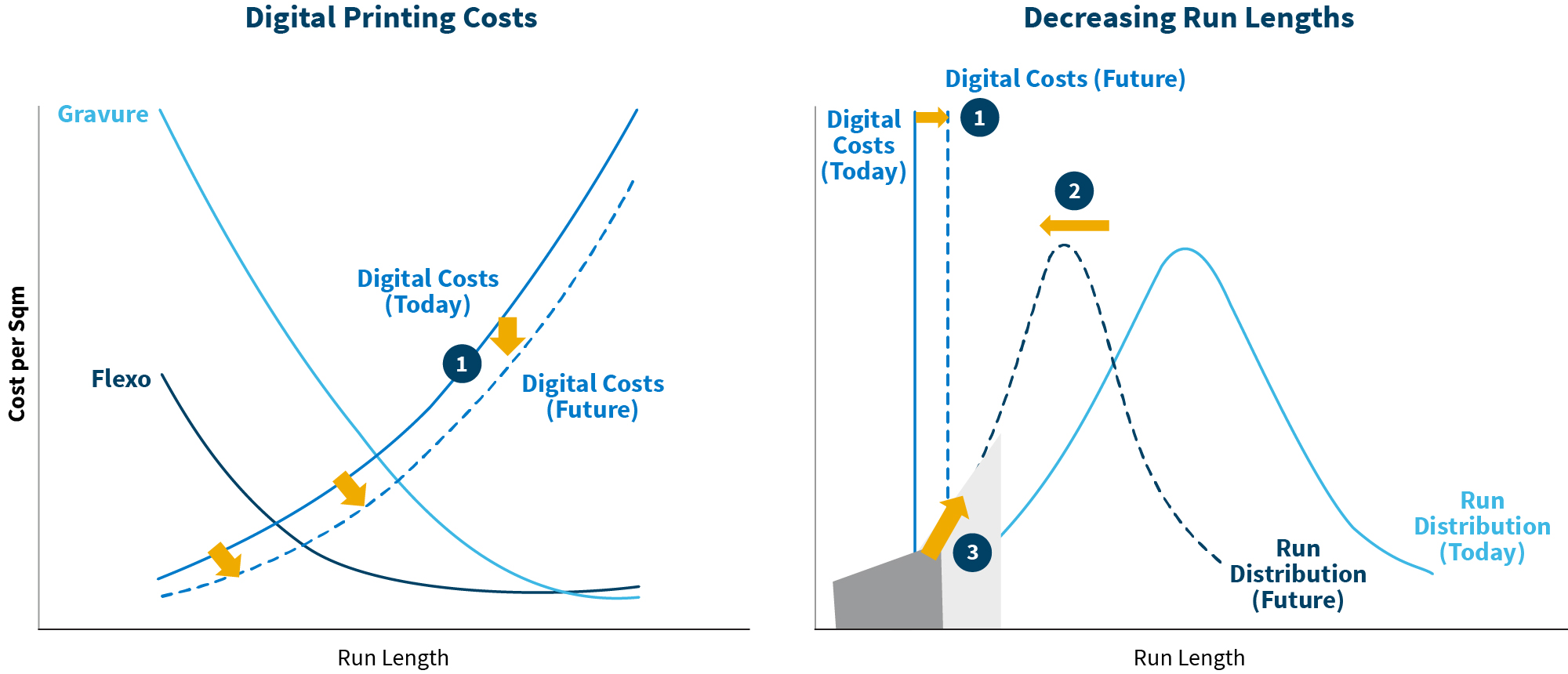
The costs of digital printing are decreasing (left), which makes the technology increasingly attractive for longer digital run lengths that have been dominated by older technologies such as flexo and gravure. Simultaneously, customers are increasingly seeking shorter print runs (right) due to SKU proliferation, increased customization, and time-sensitive ordering and changes. As a result, digital printing’s economically addressable underlying volume is poised for growth.
Digital Printing’s Value Proposition
Digital printing’s value long centered on the fact that changes during print runs are easier (and less expensive) when compared with traditional methods, mostly because digital changes don’t require complicated and sometimes manual work to adjust printing plates. Changes and customization were more difficult and expensive with traditional printing methods, but customers could—and still can—benefit from economies of scale on extended print runs when compared with digital printing.
That gap remains, but it is shrinking. As a result, the economically addressable volume for digital printing is increasing, as is its market penetration (see charts).
Digital printing offers other comparative advantages. Turnaround time for orders can shrink from weeks to days, single runs can more easily accommodate multiple SKUs, and the absence of printing plates means less waste and comparatively lower setup costs.
This has traditional converters that focused on flexo and other older platforms considering digital printing through strategic acquisitions. Smaller digital converters may benefit from a larger platform’s commercial reach, capital, and operating infrastructure.
M&A Implications for Strategics—and Beyond
These factors have legacy players buying pure-play digital platforms to position themselves as hybrid providers that also offer digital and traditional printing. But other combinations of M&A activity also highlight current trends in the sector, including Butterfly Equity’s January acquisition of ePac Flexible Packaging. [1] Butterfly, a Los Angeles-based private equity firm, focuses on the food sector, and William Blair advised it on the transaction.
EPac is a high-growth flexible packaging converter focused on digital printing for small and midsize businesses. Founded to provide locally based consumer packaged goods companies with the ability to compete against large brands, ePac has a nationwide footprint and a significant library of specialized designs, including pouches, sachet packaging, and customizable roll stock. The investment was Butterfly’s first in packaging, which it called “a critical component of the food value chain” when the transaction was announced.
In a similar vein, many strategic acquirers have recently—and selectively—added digital printing capacity and adopted hybrid strategies. Part of the thinking is that some smaller customers currently served by digital printers will grow and possibly need the longer print runs that make flexo more economically advantageous.
EPac’s leadership team partnered with Butterfly Equity in the transaction, and CEO Virag Patel noted that the “partnership allows us to continue disrupting the industry while leveraging Butterfly’s connectivity throughout the food and beverage ecosystem.”
Looking Ahead
The ePac transaction likely served as a signal to other private equity investors about digital printing’s direction. But it is also indicative of why buyers are active in the space—recurring brand relationships, platform scalability, and the opportunity to build technology moats that come from acquisitions.
For converters, some of the transition to digital could come organically. But if they are thinking about bolt-on acquisitions, there are important diligence considerations, including the sustainability of the target company’s growth, its capex cycle, and customer concentration and churn.
Given where the market and technology are heading, conventional converters should evaluate this strategy as a way to add digital capabilities. William Blair has extensive experience in the printing space and would welcome the opportunity to discuss trends affecting the market.
-
Information about Butterfly Equity’s acquisition of ePac Holdings comes from a company press release announcing the transaction. ↩
Disclosure
“William Blair” is a trade name for William Blair & Company, L.L.C., William Blair Investment Management, LLC and William Blair International, Ltd. William Blair & Company, L.L.C. and William Blair Investment Management, LLC are each a Delaware company and regulated by the Securities and Exchange Commission. William Blair & Company, L.L.C. is also regulated by The Financial Industry Regulatory Authority and other principal exchanges. William Blair International, Ltd is authorized and regulated by the Financial Conduct Authority (“FCA”) in the United Kingdom. William Blair only offers products and services where it is permitted to do so. Some of these products and services are only offered to persons or institutions situated in the United States and are not offered to persons or institutions outside the United States. This material has been approved for distribution in the United Kingdom by William Blair International, Ltd. Regulated by the Financial Conduct Authority (FCA), and is directed only at, and is only made available to, persons falling within COB 3.5 and 3.6 of the FCA Handbook (being “Eligible Counterparties” and Professional Clients). This Document is not to be distributed or passed on at any “Retail Clients.” No persons other than persons to whom this document is directed should rely on it or its contents or use it as the basis to make an investment decision.