Midmarket technology private equity firms and their portfolio companies have become an important exit pathway for VC-backed companies, especially in the AI era.
The share of VC-backed companies exiting to technology buyout firms has risen over the past quarter-century, and especially over the past decade, when compared with other exit pathways, such as going public through an IPO or a sale to a strategic acquiror.
U.S. VC-to-PE Buyouts Compared With IPOs as Percentage of Total VC Exits (2000-2025)
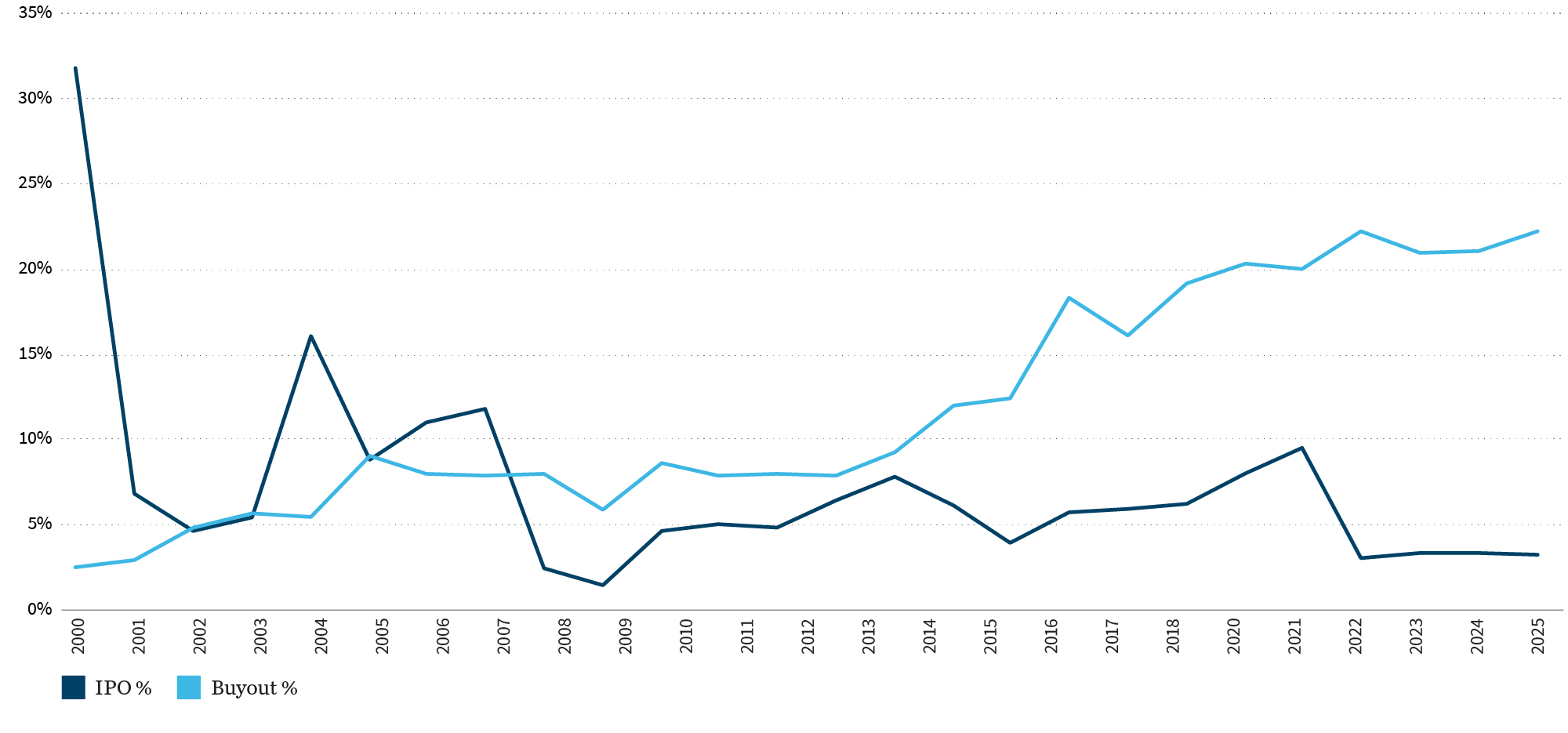
There are many reasons for this continued trend, including the multi-decade decline in IPOs and the structural shift in the public markets, the growth of the private equity industry during the same time period, and the pressure on venture capital firms to generate liquidity and returns for their limited partners. More recently, private equity firms are targeting VC-backed portfolio companies not only as standalone platform investments but also to reposition their own software portfolio companies for the next stage of growth. For sponsor-backed software platforms, acquiring VC-backed technology companies is an alternative to internal development, allowing them to accelerate their product roadmap while adding talented individuals to the team. The AI revolution of the past few years is accelerating these trends.
In this article we examine private equity’s growing role in VC-backed M&A, highlight a recent representative transaction, and discuss how the three parties typically involved—venture investors, private equity firms, and company leaders—can better understand one another.
A Growing Exit Pathway for VC-Backed Companies
Historically, software tuck-in acquisitions were about geographic expansion, customer cross-sell opportunities, or incremental product adjacency. But that has changed with the rise of smaller technology-focused private equity firms, many of which have spun out from larger technology buyout firms. The smaller firms are more apt to acquire VC-backed businesses, which are often too small for larger firms to target.
These trends were increasingly clear as the 2020s dawned. But the emergence of AI has made technology central to sponsor value-creation plans across a range of sectors, including vertical software, workflow automation, developer tools, enterprise productivity software, data and analytics platforms, and customer-engagement platforms.
Case Study: Haveli Investments’ Majority Investment in Sirion
One transaction that is a compelling example of these dynamics occurred in early 2026 when William Blair client Sirion, a leading provider of enterprise AI for contract management, was acquired by Haveli Investments. Sirion, a portfolio company of a number of prominent global venture capital firms (Peak XV Partners, Tiger Global, and others) helps enterprises create, store, and manage contracts through its specialized, first-of-its kind, agentic operating system.
At the time of the transaction, the company supported more than 7 million contracts across over 100 languages for many of the world’s largest enterprises. After years of strong support from the venture community, Sirion brought in Haveli Investments as a new majority shareholder.
Haveli (founded by Brian Sheth, ex-president of Vista Equity Partners) prioritizes middle-market enterprise software companies with modern products, attractive markets, and with opportunities to apply growth levers to accelerate performance. It saw Sirion as an excellent fit for its strategy and the transaction (completed in February) provided liquidity for venture investors while giving founder and CEO Ajay Agrawal an ideal operationally oriented partner in Haveli to help him scale the business into the agentic future.
“With Haveli’s partnership, we are accelerating our mission to make contracting intelligent, continuous, and deeply integrated into how enterprises operate,” Agrawal said after the transaction was completed.1
How the Players in VC Exits to PE Think Differently
While each transaction is unique, the Sirion deal shows the standard set of players in VC exits to private equity: company executives who have spent years building an enterprise; a venture fund (or funds) that invested in subsequent years; and a private equity firm with a technology focus interested in a majority or minority investment. But these groups think and operate very differently.
Although venture capital and private equity firms are focused on investing capital and generating returns, the two groups operate in different worlds, with little connectivity. VC-backed companies can sometimes feel underwhelmed by private equity offers, particularly those initially focused on outsized returns through a strategic M&A event or an IPO. Private equity investors might face the unfamiliar situation of working with multiple VC investors who have differing time horizons and goals. Company leaders, who often have poured their hearts and souls into a business because of its mission and upside, might balk at private equity’s reputation for a leverage-and-control playbook.
But evolving market activity and sentiment show that these parties are increasingly motivated to work together. We noted above what is prompting private equity and venture capital to change their thinking. For company leaders, partnering with private equity is an opportunity to secure much-needed funding, clean up capital structures, and create greater strategic value inside scaled software ecosystems.
Navigating the Perspectives of VC, PE, and Founders
It is critical in these processes, and for smooth operations post-transaction, that the parties understand how their counterparts operate and what they value. Perceptions might be dated or overgeneralized, and each party should be judged on its own merits.
Venture investors and founders should put aside stereotypes about private equity and assess potential partners on whether they can execute the company’s vision by evaluating the firm’s thesis, relevant experience, and plan for the business. Indeed, the right private equity partner can bring sector expertise, help companies execute a growth plan, and assist with future acquisitions.
Private equity firms should be prepared for diverging interests among venture investors during the transaction process and remain open to a range of transaction options. Some venture investors might be most interested in exiting and generating liquidity, while others want to remain involved with the company and are happy to roll all or some of their proceeds.
But each deal and set of parties is different, and the evolving market underscores the value of outside advisors who deeply understand both the venture and technology private equity ecosystems. William Blair’s strong relationships with venture-backed technology companies and technology-focused private equity firms position us at the intersection of these converging markets.
Please don’t hesitate to reach out to discuss exit pathways, AI’s impact on software, and other trends across the venture capital landscape.
[1] Source: Sirion press release, February 23, 2026.
Disclosure
“William Blair” is a trade name for William Blair & Company, L.L.C., William Blair Investment Management, LLC and William Blair International, Ltd. William Blair & Company, L.L.C. and William Blair Investment Management, LLC are each a Delaware company and regulated by the Securities and Exchange Commission. William Blair & Company, L.L.C. is also regulated by The Financial Industry Regulatory Authority and other principal exchanges. William Blair International, Ltd is authorized and regulated by the Financial Conduct Authority (“FCA”) in the United Kingdom. William Blair only offers products and services where it is permitted to do so. Some of these products and services are only offered to persons or institutions situated in the United States and are not offered to persons or institutions outside the United States. This material has been approved for distribution in the United Kingdom by William Blair International, Ltd. Regulated by the Financial Conduct Authority (FCA), and is directed only at, and is only made available to, persons falling within COB 3.5 and 3.6 of the FCA Handbook (being “Eligible Counterparties” and Professional Clients). This Document is not to be distributed or passed on at any “Retail Clients.” No persons other than persons to whom this document is directed should rely on it or its contents or use it as the basis to make an investment decision.