


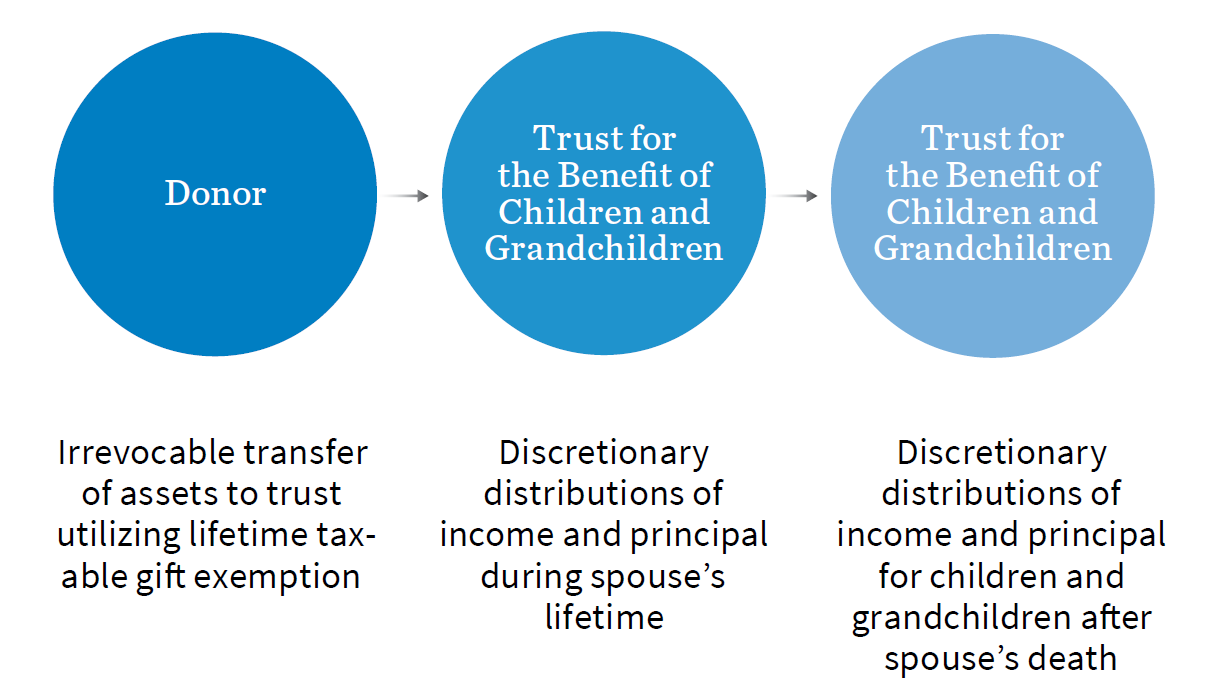
The SLAT is a type of irrevocable trust used to transfer wealth outside your estate in which one spouse creates a trust for the benefit of the other spouse and his/her heirs. The trustee of the trust is authorized to make distributions to the grantor’s spouse, during the spouse’s lifetime, should the need arise.
The Spousal Lifetime Access Trust (SLAT) has become an increasingly popular estate planning technique for married couples; it is of particular interest to those wanting to take advantage of the historically high federal estate tax exemption level.
The SLAT is an irrevocable trust that one spouse creates for the benefit of the other as well as for additional heirs; although it is irrevocable, the beneficiary spouse may receive distributions of income and principal from the trust, allowing the couple to access the gifted assets. Typically, when irrevocable trusts are created, the donor relinquishes all interest and access to the assets transferred to the trust. With the SLAT, however, the donor spouse has indirect access to distributions from the trust through the beneficiary spouse. For married couples who are interested in making large, irrevocable gifts today but are concerned that they may one day need access to the gifted assets, the SLAT provides a solution that may be the best of both worlds.
In fact, both spouses can use their combined exemptions and create SLATs to benefit the other, doubling the exemption amount sheltered from gift and estate taxes. The donor spouse can even allocate the exemption amount from the generation-skipping transfer tax (GST) to the SLAT, making the trust exempt from estate tax for many generations to come.
Spouses interested in executing SLATs for each other’s benefit need to be wary of the reciprocal trust doctrine, which allows the IRS to treat the gifts as if they had never happened. While there is no bright-line test to determine whether the IRS will invoke the reciprocal trust rules, practitioners agree that a prudent approach is to make the trusts as different as possible given the circumstances. Some variations may include different beneficiaries, trustees, access to trust income and principal, and trust creation and funding dates.
With this in mind, it is vitally important to work with your wealth advisor and tax professional to carefully determine the amount you can gift to the trust before you make the transfer. Even with the spouse having access to the trust, you should not count on the assets once you transfer them. Most advisors and attorneys recommend that a sufficient amount of assets remain outside the trust to meet your lifetime needs and that the beneficiary spouse not request distributions from the SLAT unless absolutely necessary. It is important to note that your access to the funds ends upon death or divorce since you will lose the indirect access to the funds you had through your beneficiary spouse.
SLATs may be a useful strategy for those who reside in states with a state estate tax. Even if you are not subject to estate tax at the federal level, you may benefit from removing assets from your taxable estate at the state level. Currently, 13 states impose a state estate tax.
Since the spouse who creates the SLAT must give up all control over the assets, he or she may not act as the trustee. In addition, if the beneficiary spouse acts as the trustee, distributions must be restricted to an “ascertainable standard,” namely health, education, maintenance, or support. Naming an independent trustee, such as a trusted family friend, provides the beneficiary spouse with broader access to SLAT assets since independent trustees may have wide discretion to make distributions for any reason.
When properly structured, the assets in a SLAT are not taxable in either spouse’s estate and are not available to creditors. At the death of the beneficiary spouse, the assets in the trust transfer to the other beneficiaries, typically the donor’s children, free of estate tax.
For income tax purposes, SLATs are generally set up as grantor trusts, meaning that during the donor’s lifetime, income will be taxed to the donor spouse on the donor’s tax return, rather than to the trust. These tax payments are not considered gifts and, in effect, enhance wealth transfer, allowing the SLAT to grow income tax free.
In summary, SLATs have become a popular technique for using the historically high federal estate tax exemption while allowing access to the assets via the spouse’s interest as a beneficiary. Please contact your William Blair wealth advisor to discuss whether SLATs may be right for you.
How a SLAT Works
Disclosure
This information has been prepared for informational and educational purposes only and is not intended to provide, nor should it be relied on for, accounting, legal, tax, or investment advice. Please consult with your tax and/or legal advisor regarding your individual circumstances. Investment advice and recommendations can be provided only after careful consideration of an investor’s objectives, guidelines, and restrictions. The factual statements herein have been taken from sources we believe to be reliable, but such statements are made without any representation as to accuracy or completeness or otherwise. Opinions expressed are our own unless otherwise stated and are subject to change without notice.