


Nonprofits are navigating rising costs, shifting funding sources, and growing demand for services. Building financial resilience in that environment requires more than responding to the challenge in front of you—it means preparing for what could come next.
That was the focus of a recent William Blair event, featuring Laura Coy, partner and head of philanthropy and sustainability at the firm; Kathy Kielar, vice president of development at WTTW and WFMT; and Liz Livingston Howard, clinical professor and executive director of the Center for Nonprofit Management at Northwestern University’s Kellogg School of Management.
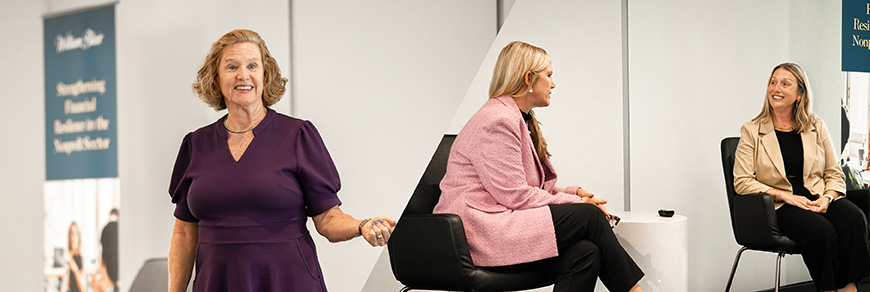
Coy and Kielar kicked off the event with a significant opportunity: the generational wealth transfer. An estimated $124 trillion is projected to be transferred globally through 2048, Coy noted, including $18 trillion already earmarked for charitable causes.
“With more wealth comes more complexity,” Coy said. “With more complexity comes the need for more planning.”
For nonprofits, Kielar said now is the time to strengthen planned giving efforts. Organizations without established programs can start by incorporating planned giving into communications already underway, rather than building a standalone program from the outset. Those with existing programs can deepen conversations with donors about bequests, beneficiary designations, donor-advised funds, IRAs, and other assets.
Howard then turned to another part of resilience: preparing for uncertainty before it becomes a crisis.
“The world is not stable,” Howard said. “Lots of things are changing, so now is the time to think about scenario planning.”
That means identifying potential risks and opportunities, considering best- and worst-case outcomes, and developing action plans before they’re needed. Howard also added that organizations should establish the conditions that would set a plan in motion rather than waiting until a funding source disappears or another disruption has already occurred.
The discussion ultimately came back to preparation. Diversifying revenue, engaging donors and boards, and planning for multiple scenarios can give nonprofit leaders more options when circumstances change—and help keep their organizations focused on the missions they serve.