


With parents increasingly looking to provide their kids with an edge, the youth enrichment sector—which spans services from swimming lessons to college admissions—is booming. It’s also emerging as a highly compelling investment category.
At the intersection of education, consumer services, and experiential spending, youth enrichment is comprised of dozens of seemingly disparate but critically linked segments. Within them are thousands of small operators, a limited number of scaled platforms, and significant white space for consolidation and value creation.
Parents increasingly view these services in the sector as core to a child’s long-term development and are turning to specialists and prioritizing high-quality, high-efficacy, and structured experiences that drive outcomes, e.g., skill building, social differentiation, and academic progression. The appetite for these services shows no signs of slowing as competitiveness among parents, fueled by peer signaling through social media, is creating self-reinforcing demand loops and a recession-resilient multibillion-dollar market.
The following article outlines the scaling factors within youth enrichment, keys to long-term value creation, what investors are looking for, and our outlook for the sector.
Challenges and Opportunities With Scaling
The growth in youth enrichment is exemplified in how children—particularly children from high-income families—are learning how to swim. Instead of lessons from a neighborhood teenager in a friend’s pool, as might have happened a generation ago, kids today as young as five months are attending swimming schools with curriculum geared for different skill levels.
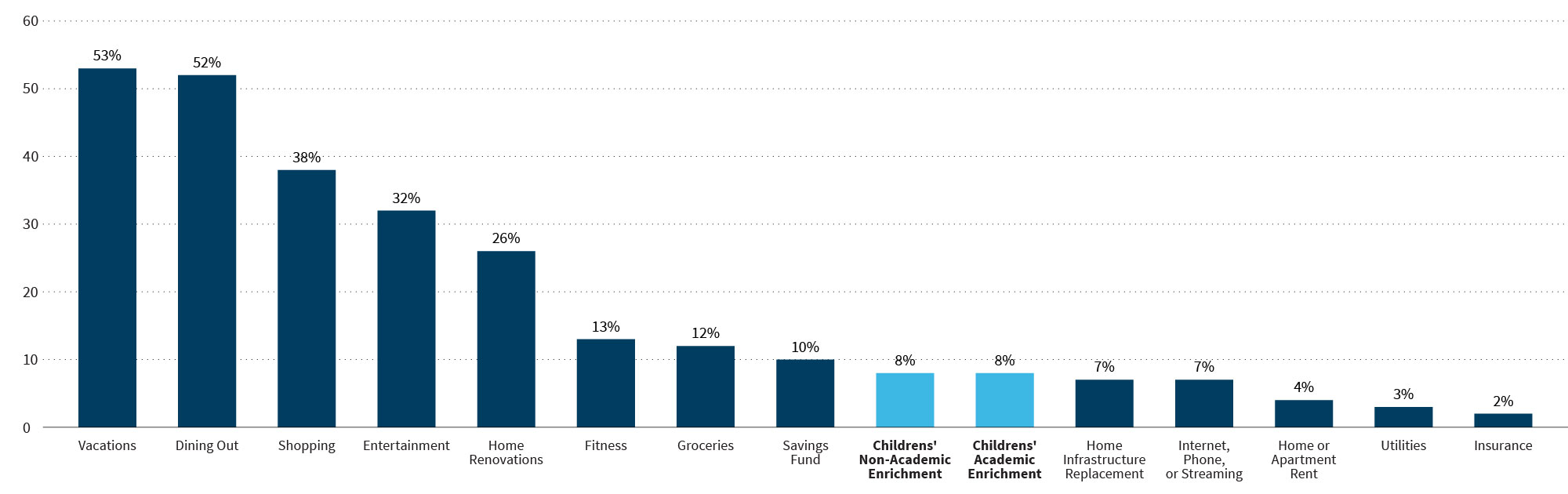
While these services are relatively new, family spending on them already shows strong signs of being noncyclical. Indeed, parents in a recent survey said enrichment is among the last expenses they would cut in the face of financial hardship (see chart).
Youth Enrichment’s Recession-Resilient Demand
Youth enrichment services—broken down below by children's non-academic and academic enrichment—are a priority for families when asked about the potential of economic hardship. The finding shows the recession-resilient nature of the space particularly among higher-income, education-focused households.
However, factors that make the sector attractive present unique challenges to scaling and consolidation:
- Local focus, high stakes: Businesses in the sector are inherently local and community-based, with support from trusted networks of families. Brand, community engagement, and high-quality delivery are critical—and failures can cause significant disruption in customer acquisition.
- Operationally intensive: The above is true in part because the sector is heavily network- and referral-based. Companies that consistently provide high-quality and high-efficacy services succeed—but those that stand out also factor in enjoyment for both children and parents. For a swim school, this could mean ensuring water temperature is optimal for children while comfortable seating is available for parents.
- Working against churn: With children naturally aging out of programs, the sector faces significant customer turnover and feeding the top of the funnel is a constant task. That makes a differentiated experience with overlapping yet unique criteria that appeal to children and families crucial.
While operational excellence is crucial regardless, companies are embracing different approaches given these considerations. One is a multiple-activity, multiple-brand strategy, in which a company operates multiple distinct youth enrichment brands across segments (e.g., sports, tutoring, and arts). While multi-segment platforms leverage shared infrastructure, customers remain attached to a single brand. But these platforms introduce increased operational risk and feel like a collection of unrelated offerings, which can undercut cross-selling abilities.
The best way to build a trusted network and scale nationally with the lowest operational execution risk comes at the other end of the spectrum—a single brand and activity dominating its category. This approach is exemplified by a summer camp with a consistent brand, operating model, and customer experience across multiple geographic locations.
While relying on a single activity increases exposure to shifts in category-specific demand, identifying organic and inorganic growth opportunities is straightforward and there are no competing operational priorities across multiple service lines.
Long-Term Value Possibilities as Investors Take Notice
Providers that can shift away from the legacy transactional nature of family relationships have significant opportunities to broadly monetize. They can build durable relationships with families—extending participation across multiple years, age cohorts, and add-on offerings—while driving loyalty through such tools as subscription discounts. Also, providers are layering in higher-margin ancillary revenue such as merchandise, take-home content, and private instruction. Those approaches can drive meaningful top- and bottom-line growth without appearing in headline pricing.
Incorporating digital layers—ranging from scheduling and communication tools to performance tracking and advancement tools—can also drive additional engagement and differentiation. Over time, successful providers evolve into multi-touch platforms that capture a greater share of a family’s time, spend, and trust.
The above steps are important because investors are increasingly discerning and less interested in undifferentiated roll-ups. They don’t only want authentic platforms with deep brand equity and embedded community trust. They also want a clear right to win within specific categories, especially given questions about category dominance versus horizontal expansion. The former has emerged as the more durable option given that depth drives long-term value creation.
Looking Ahead for Youth Enrichment
The youth enrichment sector is likely to remain highly fragmented over the next 5-8 years, despite recent consolidation. But investors will seek out operators that connect the necessary high-quality local execution on a broader geographic scale.
The most attractive providers will have institutionalized their trusted network of families, standardized the experience without diluting authenticity, and captured broader LTV through deep family engagement. Additional opportunity will emerge around tech-enabled platforms and tools that help parents navigate and optimize the increasingly complex ecosystem of enrichment and development offerings.
The sector is still in the early stages of holistic childhood development where outcomes, premium experience, and evolving parental psychology expand the total addressable market and pathways for value creation. William Blair has extensive experience working in this sector so please don’t hesitate to reach out if you have questions or would like to discuss market trends.
Disclosure
“William Blair” is a trade name for William Blair & Company, L.L.C., William Blair Investment Management, LLC and William Blair International, Ltd. William Blair & Company, L.L.C. and William Blair Investment Management, LLC are each a Delaware company and regulated by the Securities and Exchange Commission. William Blair & Company, L.L.C. is also regulated by The Financial Industry Regulatory Authority and other principal exchanges. William Blair International, Ltd is authorized and regulated by the Financial Conduct Authority (“FCA”) in the United Kingdom. William Blair only offers products and services where it is permitted to do so. Some of these products and services are only offered to persons or institutions situated in the United States and are not offered to persons or institutions outside the United States. This material has been approved for distribution in the United Kingdom by William Blair International, Ltd. Regulated by the Financial Conduct Authority (FCA), and is directed only at, and is only made available to, persons falling within COB 3.5 and 3.6 of the FCA Handbook (being “Eligible Counterparties” and Professional Clients). This Document is not to be distributed or passed on at any “Retail Clients.” No persons other than persons to whom this document is directed should rely on it or its contents or use it as the basis to make an investment decision.